Top Ten Tiresome Frugality Listicles (That You Should Stop Writing)

I do a lot of reading on budgeting, couponing, and ways to cut costs. It’s become very apparent to me that most people who end up in my search results do not bring new recommendations to the table and are, instead, taking each other’s existing listicles or Reddit comments and repackaging them, or speculating based on their imagination, without much regard for people looking for this advice.

And I’m over it. Here’s my pet peeves:

Budgeting advice for people who already actually have money

I make about $1,700 a month. About 20% of this is skimmed off for taxes, because I don’t claim any exemptions on my I9. I try to automatically divert another 20% (post-tax) into my savings. And to be clear, I’m not currently saving up for anything fun or exciting. I’m just trying to have any savings at all. It doesn’t last because it basically all gets pulled back out for a surprise expense. I am several thousands of dollars in debt and cannot currently opt out of incurring more debt because I have a terminally ill dog whose meds, which are currently helping him immensely, cost like $200 a month, and the main thing I am saving for at the time of writing is his end-of-life and post-mortem expenses.

I live with family, but cannot justify dipping into their funds beyond a periodic purchase. I am on the edge of making too much for Medicaid in my state if I pick up even just a few extra hours a month right now, and I cannot justify coming off Medicaid because I don’t have enough left over to pay the premium on a marketplace plan. And mind you, I live in Pennsylvania, where there is no Medicaid gap. It also means that I have to be extremely careful about receiving financial help, because again, I cannot afford to not be on Medicaid.

Because I am on Medicaid (apparently the letter announcing I was getting kicked off was an error which nobody has an explanation for beyond, “sometimes correspondence is just wrong”), I currently have to pay out of pocket for therapy. Technically, therapy is an optional expense, but I’ve lived with being mentally ill long enough to know that I will not survive without therapy. This is $180 a month for my one and only session. If I was on a marketplace plan and could hand this off to insurance, $180 would probably cover two sessions, at worst. The difference between monthly and fortnightly therapy sessions in terms of my quality of life is astronomical.

And yes, that means, it costs me more to be on Medicaid. I still can’t afford to not be on Medicaid. Especially because I needed to go through PT for pelvic pain that has plagued me for months on end, and they already pre-approved the PT. I cannot justify upsetting any of that, because when your pelvic floor is locked up, it’s hard to do much of anything.

Further, when I look at how people get by with similar incomes to mine, it turns out they’re already homeowners, and own cars, or live in places where a car isn’t necessary and it actually makes sense to go by foot or use transit. But I do not own a home. I do not own a car. I live in the country. And even then, I have the advantage of having conditional access to the cars of the people I live with.

Sometimes people just don’t have the cash flow. Even with help, even with what looks like other options, an individual person can still end up just being poor.

Lists of things to start or stop doing (that people already do, or don’t do)

Or, you know, can’t do, or can’t stop doing. I don’t have cable. I don’t have streaming services, and if I have to stream something I either use my parents’ accounts (which they encourage) or use free sites with a dubious legal status. (That said, all those sites swear up and down that they’re legal.) I use a phone plan that I pre-pay in July for the full year that, I think, I got a pretty sweet deal on. Even then, I had to wait for a paycheck to hit to make use of an additional discount that they were offering. I live with other people and am not at liberty to mess around with the water heater to save a few bucks a month. I am meticulous about electricity usage. I already make my own laundry powder. I buy most groceries according to best possible unit price, I use a price book, and I stack store sales, coupons and rebates to the extent that these options allow. (This is not counting the fact that I prioritize Zapatista coffee, and pastured eggs from a farm around the corner, because I think these are very worthwhile exceptions and I still take the frugal option available by buying bulk.) I then collect more rebates through receipt-snapping apps. I rescue discarded food from my workplace. (I donate the good stuff, save the borderline stuff for myself, and give the edible but unappetizingly ugly stuff to the ducks.) I forage fruit and herbs. I cook from scratch when I have time. I turn bones into stock, which I freeze and can, and I turn meat scraps into scrapple. I walk when it’s practical to do so—in a rural area.

I am always trying to find a way to extend my ability to stretch a dollar, and no matter how I go looking for this information, everything recommended is either entirely irrelevant, or telling me to drop things I’ve never done or haven’t done in years, and start doing things I’ve already been doing for years. I have no interest in the 101-level money saving tips. I’m trying to branch out. And if I google extreme money saving tips, I insist that they actually be extreme.

Quit telling me to cut cable!

Advice that hasn’t been relevant in years

I’ve largely dropped “thrift store” as a phrase from my vocabulary. They’re secondhand stores, but they’re not really that thrifty anymore. Not since thrifting has come to be treated as a personality trait or the beginnings of a business venture, and these increases in demand, plus background inflation, have driven the prices up.

On top of this, brick and mortar secondhand shops haven’t been a place where I bother doing most shopping for a long time, especially because the only item I consistently need to replace is pants. I’m short and fat, and the chances that I’ll find a 40w/28L pair of jeans new in a brick and mortar shop is so slim as to be functionally impossible. I do not have the skills to hem jeans. I cannot emotionally handle trying on a bunch of pants that are absurdly long on me and I won’t. And even 28L is too long, my inseam is actually 26 inches. But good luck finding men’s jeans in that size.

I have had my victories in secondhand stores—my $9 Anywear clogs, my armchair, an absolutely bitchin‘ Scherenschnitte of two roosters, an enamel bowl with a wide flat bottom perfect for making salads—but finding clothing in them has become something with basically no return on investment. If I only buy what I need, and if what I need is clothing, then there’s nothing for me there.

When I buy clothes secondhand, I get them on eBay, which is where I’ve snagged my overalls that I basically live in. Mercari is too expensive (because it’s expensive to sell on Mercari, too) and Poshmark puts too much emphasis on brand.

Generalizing advice that’s only regionally relevant

I only lived in a city for about four months and it was extraordinarily expensive for me, because I couldn’t adapt my established tactics for saving money to the environment I was in. If you don’t have adequate storage space, you can’t buy bulk. If you don’t have a car, any bulk buying has to happen online or through a delivery service, which kind of negates the savings. Foraging potential is dubious (though I do know people who forage fruits and nuts in the city), though dumpster diving might be easier. You can’t grow veggies without either floor space or outdoor space and you definitely cannot legally raise your own livestock in the city—even if there’s room, you’d have to plan around zoning or your neighbors ruining it for you. I, for one, do not like the idea of leaning on my neighbor’s good graces not to snitch. Especially because the neighbor I shared my bedroom wall with in Philly was regularly blasting bassy music at 3 in the morning. Hated that guy.

Affiliate links to things that are only cheap for the first month or year

We are all going to do things we’re not proud of to make money. I applied to a contractor job as an AI trainer and I was emphatically not thrilled with myself in the slightest, but I did it because I was nannying on top of my day job and needed more money and needed something I could do while the baby was sleeping.

(Thankfully there were technical issues that prevented me from signing into the project at all, so my conscience was saved.)

Most affiliate marketing is really whatever to me at worst, but I think it’s disingenuous when you’re running a blog on saving money and you offer coupon codes for things that very quickly stop being the frugal option. Being frugal is about saving your own money, not trying to wheedle it out of other people. Some forms of affiliate marketing could really stand to elicit a bit of shame.

Related, I’ve developed quite a distaste for How To Run A Blog-type blogs. Over it.
A Dysphoria-Friendly Option for Trans Dudes On Their Period (Which Is Also Slightly Frugal)

There’s a ton of thinking out loud to go with this. Bear with me.

I didn’t buy from a trans-friendly, LGBTQ+ operated company when I went looking for period underwear. Instead, I went on Amazon and ended up buying leakproof boxer-briefs designed for cis men with urinary incontinence, in a style that had the leg and butt coverage you need when you’re on your period.

It’s reductive, I guess, to say that period underwear is just overpriced incontinence underwear. A fairer assessment is that they’re constructed with identical functions in mind: Absorb and trap liquids, and ideally do so with wicking and odor control. Specifics around coverage and the marketing are going to be the biggest difference. The marketing difference is not nothing, though.

For one, I suspect most people aren’t thinking of these items as interchangeable (I certainly didn’t when I first went looking, what tipped me off was a review on period underwear mentioning it was good for incontinence), and they aren’t always interchangeable because the placement of the absorbent material differs between styles, and people who aren’t living with urinary issues might hesitate to buy something marketed to address a problem they don’t have.

And, like, okay, no, menstruation is not exactly a problem to be solved. But, if something is marketed for menstrual care, you do get some degree of reassurance that the product is designed to be effective for it.

And while cost was a factor, it wasn’t the primary reason I opted not to make what would have been the more ethically consistent purchase. My needs around my dysphoria were.

I can’t wear underwear that’s not designed for cis men. And when I say I can’t, what I really mean is I won’t, because I can’t cope. It feels claustrophobic and makes me way too aware of what I do or don’t have. And at the end of the day, I don’t really want to buy underwear from a brand that implies I am a woman, or that isn’t discreet about what I’m purchasing. That’s not how inclusive branding works.

This isn’t some victorious “I’m too smart for marketing” kind of post. Sometimes spending consciously means intentionally purchasing the more expensive option. Zapatista-grown coffee costs more than Folgers, but unlike Folgers it helps financially support the efforts of an autonomous Indigenous movement. Pastured eggs are more expensive than caged eggs, or most eggs you’ll find in the grocery store that are allowed to claim the “free range” label, but I live right around the corner from the ranch where those eggs are laid and I can confirm that the chickens have literal acres of room to hang out—and I’m putting money into local, family-run, regenerative agricultural projects. The food I sell at my day job is not cheap, for a reason.

So, too, with companies specifically created by, and for, LGBTQ+ people, with fair wages and responsible material sourcing, and operating under body-positive, trans-friendly, and feminist ethics. Whenever you can prioritize that, I genuinely believe that you should.

But sometimes you just can’t swing a full US$26 for one pair of underwear from a company whose name implies you’re a GNC woman, and your pelvic floor is too angry for a menstrual cup, and briefs that would let you wear pads aren’t gonna cut it (but they do cut into your bearish thunder thighs, because you just have to have a whole lot of rotten luck down there, apparently), and you feel bad enough that you’re just going to take the cheaper and more dysphoria friendly option.

And that’s fine.

Anyway—I went with these, which work out to around $19 per pair. This is not an affiliate link.

What Do You Do With A Bag Of Ham Bones (Ear-ly In The Morning)

(Or any time of day, I guess.)

Half of our freezer space was taken up by bones, or whole birds for roasting. After yet another round of looking for a brick of scrapple I made in, like, March without success, I lost my patience and decided the bones needed to be dealt with. Since the ham bones took up the most space, I dealt with those first.

Step one: Stock

Stock is easy, especially because I have an Instant Pot (and no professional affiliation with Instant Pot) so I can get bones in water and cooking for 3 days without having to think very hard about it.

(Don’t be like me, where I am stupid and run it continuously. Take out the insert and stick it in the fridge overnight so your unit gets a break.)

It came out gelatinous as all get out. Here’s a clip from right after skimming the fat off of cooled stock.

I then had to re-heat it to strain out the solids (including a few stray bones), and then stick it back in the fridge to cool and get wiggly again. Unfortunately, as far as I’ve been able to find, I can’t pressure-can ham stock safely, so it went into the freezer. Even then, it takes up way less space than it would as a bag of loose bones.

Step two: Bone meal

Bones get crumbly if you cook them long enough for stock. I don’t like to waste anything that comes off an animal because it’s disrespectful, and bones have phosphorus in them, which helps plants develop roots and flowers. Pop them in the dehydrator, or the toaster oven on low, and once dry, smash them until they can be ground down. (I saw on one message board that people put larger bones inside a feed bag and smash them with a mallet.) Or, cook them until they’re crumbly and then strain and dehydrate them, if you wanna take the Salt In My Coffee approach.

Step three: Scrapple

After removing the solids, if there’s still any flavor left, it can be mixed with a few ladles of stock, a starch of your choice (buckwheat flour is traditional and gives scrapple its grey color, but I use corn meal), and a little bit of sage and other spices. I mash the scraps with my fingers until they’re pretty goopy, which also helps me find and pick out any tiny bits of bone. In addition to the sage, I added a little mustard, but no salt since there was plenty in the ham scraps and stock. Cook the mix of meat scraps, stock and starch until it’s very thick, making sure you scrape it off the edges of the pan regularly. When it’s at a point where it’s a little wetter than Play-Doh texture, transfer it to a loaf pan to cool, or bake it first to dry it out even more if you want. (But, cool before slicing no matter what.) If you want, you can then put it in a bag with as much air removed as possible and stash in the freezer. Slice and fry to cook it like normal. I’ve found that, as long as you can slice it while frozen in the first place, scrapple will cook from frozen just fine.

I like it crispy.

Step four: Rendered fat

Ironically, last time I was rendering fat from a ham, I had Porco Rosso playing in the background.

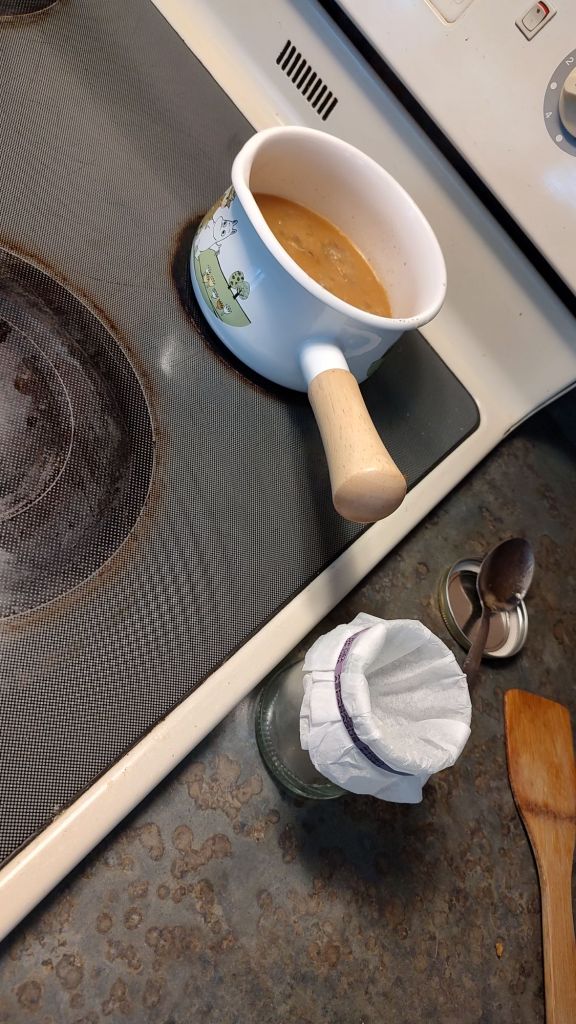
Skim the fat layer off the top of cooled stock, heat it in a little pan (I like my Moomin milk pan, which I use for basically everything) until the remaining water has evaporated, and then pour it through a filter of your choice into a jar. (Or, maybe I should get the oil pot that matches this milk pan.)

Even though I’m using a coffee filter in this image, I’ve found they’re actually pretty terrible for straining fat. Cloth filters will suit this better. Also, choose a jar that isn’t too deep, so you don’t have to root around in it to scoop the fat for cooking. I’ve found out the hard way, albeit with homemade granola, that poking around with a spoon too aggressively, and at a bad angle, can lead to a shattered jar.

RIP chocolate granola.

This is great for frying eggs, except the ones I make for my dog. Because my dog gets pastured eggs for breakfast every day since the omega 3s are good for his heart. But his are fried in olive oil or duck schmaltz for a low sodium option, which ham fat is not.

Did you know that dietary cholesterol isn’t a thing that has any real effect on dogs? That’s wild to me. I love that for them.

Forays Into Frugality: A Discount Stacking Experiment

So, it turns out that I was theoretically eligible for EBT for a good long while, somewhere in the neighborhood of three years. It didn’t occur to me until I was kind of forced onto Medicaid by the state insurance marketplace that I should probably just go ahead and see what else I qualified for, since I wasn’t likely to start making enough to be off of these programs any time soon. (Mind you, I like my job very, very much, and I enjoy an excellent hourly rate. I just don’t work full time.)

I had always kind of figured that, because I lived with people who made significantly more money than me, that I didn’t have the right to use these resources. But the thing is, if I never do, then I may never get to achieve some degree of independence. The other thing is, I paid into these programs before I needed them, and I still pay into these programs even while I am in them. It’s not like the state stops skimming a little bit off the top of my income just because I use what it’s funding.

While I was waiting for final determination on my SNAP application I decided to brush up on my ability to stretch a dollar because I figured it behooved me to account for the possibility it can be as little as $23, which is the state minimum, or even none at all if my application was rejected outright.

It was, because my caseworker claimed she couldn’t read my pay stubs, which I sent in twice. Then my income was counted as being twice as much as it actually was, and I got kicked of my Medicaid. Thanks a whole lot, Pennsylvania DHS.

I did two challenges for myself over the span of two weeks. In the first week, I challenged myself to do a grocery run with a list prepared based on what I felt like getting, but limited to the paper cash in my wallet. (US $26.) This forced me to prioritize, compare unit prices, and knock several things off my list to make my limit. I managed to get it down to a full dollar and some change under my limit. No pre-selected coupons, few sales, and only one rebate.

By the second week, I had gotten my tax refund and had some more wiggle room, and I had a chance to do more research and planning.

I combed through Ibotta, SwagBucks, InboxDollars, and the Acme store app to see what rebates and sales were available to me. These rebates can’t stack with manufacturer coupons, but they can stack with store sales, and that seems to include digital coupons linked to the loyalty card. These apply at the register like a normal sale price.

I then opened Google sheets and made a spreadsheet of what items interested me from each of these rebate and reward apps, and took note of which ones might stack. (As it happened I ended up buying none that stacked that week, except for vegan spam, which Swagbucks inexplicably considers ground meat.) I also signed up for Care Club and sent in a photo of my receipt, because I buy a lot of Lactaid products and am therefore eligible for rebates through that, and I could stack them with the store sale on cottage cheese and ice cream.

The white tag (i.e. non-sale) price of my haul would have been $148.39. This included two impulse buys, which were two packs of apple-prune baby food for my nine-month-old niece who I bring with me to get her out of the house, and a wrap for myself. With store sales, plus loyalty coupons, and a BOGO deal, I saved $49.57.

My rebate from Ibotta—and this is where the spreadsheet is most handy, I think, because I tracked my rebates per app at the bottom—was $6.70. My rewards for snapping a receipt from Swagbucks was $0.02. InboxDollars was $0.03. ReceiptHog was 15 coins, and as each point is worth half a cent I will round down and count this as $0.07. Fetch was 100 points for the receipt itself, or $0.10. Care Club awarded me 150 points, each worth half a cent if redeemed and therefore equaling $0.75, which was my second biggest rebate. Therefore, in stacked rebates, I got an estimated $7.67. If we add rebates, then I saved a total of $57.24.

Not bad.

What I’m going to do going forward is refine my spreadsheet method and experiment more with planning around combining sales and rebates, especially for shelf stable goods. Thankfully, this is what a lot of rebates and coupons tend to be for. Second, now that I have my driver’s license (at the tender age of, uh, 31) I’m going to start amassing direct mailers and be more tactical about where I direct my trips, instead of being limited to where I can walk. One of my options opening up is the Amish-run grocery outlet, which will be interesting for shelf-stable goods.

Finally Moving to WordPress

After much screaming and crying and purchasing of hosting plans and gnashing of teeth I’ve decided to stop lying to myself about my ability to tolerate Blogger’s CMS. (It’s hideous! It’s clunky! And it’s not even lemon-scented!) Figured I’d go ahead and make the best of WP’s offer to spot me the cost of domain ownership for a year. Even with the block formatting nonsense, it’s still my much-preferred CMS.

Domain is transferring now (again, after the aforementioned screaming, crying, gnashing) and I am hoping (although this did not bear out with my other blog, though that was a spiritual essay blog, a niche that I desperately need a break from) that having this cost me actual dollars will motivate me to both work harder on my Etsy store and make more of an effort towards writing for this blog. While I don’t really have the free time to opine about gardening (and indeed don’t really have access to a deerproof section of garden), I still can revel in the few chances a week I get to cook something out of rescued produce. Because now I work somewhere that lets me rescue discarded food and donate it or (if it’s expired and I trust it) take it home and eat it. It’s the bomb diggity.

We Have a Fence!

Other than the planning, my brother has done most of the hands-on work regarding the vegetable garden. I had overheard discussions about how to build a fence between him and mom, but had (mistakenly) gotten the impression that he was simply in the planning stages, unaware that this whole time he had already been hauling metal posts and wire fencing out to the garden.

Eventually he came back in the house and–get this–actually asked for help. This mostly just ended up involving me helping pull the fencing taut and then holding it in place, with the occasional help bringing more wire fencing panels out of the barn or scavenging them from fencing that was wrapped around the yew bush near the house.
We need to trim that. Anyway–
My mom came down to watch, after I brought a bench down so that people would have a place to rest while working in the garden, and she snapped exactly two progress shots. I think this one is the more flattering of the two.
As I write this, she’s helping to add compost to the garden. I’m hanging back because my meds make me heat intolerant and it’s pushing 90 farenheit. (I had to briefly dip into the house during the fence building, too. Once we got past the hottest part of the day I was good to go.) Even walking into the shady side yard to go investigate the sound of a tree falling was pushing my luck, because every second out on the field in direct sunlight to get there is brutal.
LiZiQi and them make it all look terribly easy. Working a remote call center job, while amazing for my sense of safety around covid, and while allowing me to actually have some energy on my days off, has made me horribly out of shape. I thought the fact that I sit on my ass during my free time was just me compensating for the fact that I have tended to work physical jobs. When I was unemployed (or at least just not gainfully employed–I do have some volunteer gigs) between March and June last year, even without a day job I was doing a fair amount of yard work, tidying and trying to keep after the house for my parents. And I was definitely more sedentary than the average person, but that’s always been the case any time in my life that I wasn’t playing sports. But with this sit-down job, and living with family again, I feel like I do an awful lot of nothing in my spare time. Even when I am doing business prep in some way.
More on that…whenever my cardboard deodorant tubes get here from abroad.
I would love to be able to to get into the habit of actually getting up when I wake up around 6am because the sun came up. I had it in my head that I could somehow train myself to get up at 6 without the lure of coffee and the reassurance that I wouldn’t be bothering anyone by puttering around. My brother manages to pull it off, but he also doesn’t talk loudly to dogs in the morning, which I do. I’ve also just never, ever been an early riser. It’s weird.
I’ve also never really been a self-starter. I’ve done random assistance jobs through, like, Stuff, or Shiftsmart, who are not paying me to mention their names. Getting myself to work on a schedule that someone else isn’t setting for me is inexplicably difficult to do.
Maybe it’s just my personality.
But if we can build a fence to thwart a deer’s insistence on eating our cornstalks–a not-insignificant part of the deer‘s personality–then perhaps I can build a metaphorical fence around my desire to loll about in bed until 10am.

oh my god I bought a scythe

https://ift.tt/1N7RyE6
via IFTTT

This is not even remotely unexpected of me and struck all my friends as hilariously on-brand, with probably the main surprise being that you can actually buy an Austrian scythe for what is not a totally ridiculous price. I paid like 150 USD after taxes at Lee Valley tools, which is a really damn competitive price.

Your jokes about Amish Paradise aren’t going to work on me, though, because I already dress like a metal Mennonite on purpose.

That’s an actual thing, by the way, though this is in Plautdietsch, and not Pensilfaanisch Deitsch:

But I can absolutely get on board with metal songs about needing to get your chores done and have a nice nap.
Anyway, I’ve wanted a scythe for a couple of years because I do kind of enjoy the process of mowing the lawn, but the electric mower gives out well before I do, and gas mowers are worse than cars as far as emissions.
And like, yeah, you can’t individually choose your way out of climate change, but considering we mow the lawn more than we drive, as a household with two people working from home and 22 acres to keep after…
The lawn at the other house, which I was taking care of before I moved to Philly and then to my parents’ farm, is getting overrun. Our neighbor keeps after the front lawn because it’s flat and easy, and it makes it easier for him to scan the property for fallen trees, which happens a lot, but I told him not to worry about the back. Too hilly, too full of trees. I wouldn’t dare ask him to deal with that. Especially since a lot of the ash trees have given way to emerald ash borer and are regularly snapping in half during storms.
And I’ve been…critical of a lot of tech for a while, especially when its selling point amounts solely to speed. And while I am not Amish (duh) I am appreciative of the metric by which Amish communities measure the suitability of technology–does this encourage interdependence? If not, it’s rejected. I am certainly less than thrilled with the way those expectations are enforced. But nothing is pro-social about a lawn, especially one being maintained with loud, dirty machinery. If I had my druthers I would buy the house off my parents and convert the front lawn into a community garden, but where I am going to come up with $300k is beyond me.
Maybe I can be like Jim Kovaleski and mow lawns with my scythe for cash. My WFH gig, while convenient, and while having a pretty good hourly wage, simply does not give me enough hours to suit my needs.
Then again, that’s what contemplating starting an Etsy store is supposed to help mitigate. We’ll see how that turns out. I’ve made a test batch of an anti-fungal salve and my brother and I have been testing it. Running around barefoot or in galoshes isn’t exactly kind to your feet, and I’ve had tinea veriscolor for years. The salve is based on an essential oil mix I saw some good results with, so we’ll see if it works in a beeswax and plant fat base. More on that story as it continues. I’m thinking of some conditioner bars and lotion bars next. And maybe lip balms since it seems like if I don’t wear lip balm for two seconds I’ll die.

Sprouts!

https://ift.tt/MErCuUw
via IFTTT


Before any of the planned plants go into the garden, I like to check what volunteers come up. In my window box, which has never sat in a window despite being set up at 3 different addresses, I see these little guys that I can’t identify.

They’re too small to get a real idea, so I’m mostly just trying to see if I can accurately guess whether the soil it’s growing in ruins any edible plants that grow in it. I may have left it too close to the roof of the first house, and too close to the roof of the shed at the apartment in Philly. And I know that, rationally, foraging in the city is actually fairly safe, at least when it’s fruits. (Shoots and roots, not so much, as I understand it.) But we were only one building away from the road, and like, I still have OCD despite working very hard on managing my symptoms.

Anyway, could be beets. Could be lambsquarters. How beets would volunteer in this box is a bit beyond me, so I suspect not.

Plant ID is still kinda new to me, and I’m really only good with edible invasive plants–which is most invasives where I am, and that’s for the very simple reason that they were primarily introduced as food, seasoning or medicine. The time you spend hating garlic mustard or dandelions for existing is time that you could spend eating them and enjoying them.

I mean, yeah, rip out the roots, because they propagate extremely easily, and they’re still invasive plants without natural eaters to balance it out without intervention. But wash and prepare and eat them, too. Be the eater. Be ~the balance~.

Admittedly I’ve never totally understood the intensity with which people (and especially other white settlers!) hate weeds, or how arbitrary the designation of a weed really is. Even the “plant where you don’t want it” criteria is ridiculous. Why are you the judge of that? Why should your whims dictate the landscape?
Anyway, there are seeds in the garden, and they are sprouting, but I’m impatient and as soon as it made sense to start buying crunchy greens from the store again, I once again started eating lettuce by itself because I got sick of all the meat I was eating over the winter. My brother usually cooks dinner. He is a very meat and potatoes kind of person. I am not. I would rather have rabbit food. But I don’t want to wait for the carrots to finish growing.
But, in the spirit of being Punk As Fuck in terms of the whole “prefiguring the abolition of grocery stores through gardening” thing, obviously, you have to be DIY. Them’s the rules.
You will find, by the way, that acting on your anarchic values does have rules, kinda. Or principles, at least. Because you have to self-govern. The magic is in the fact that these are not rules made by some centralized authority that doesn’t know or care about you, so if you make up the rules, you can follow rules that are organic (astonishingly not an intentional pun) and that actually make sense.
Usually. There are exceptions, what with the whole OCD thing.
I might have violated my principles a little (a lot) by buying the 4-pound bag of mung beans off of ~the Zon~ but unfortunately ~the Zon~ has created a feedback of loop of being able to offer the best variety and sometimes lowest prices, and then doing so, furthering its monopoly.
And anyway, I think you can utterly despise a corporation or institution and still be stuck using it. That’s usually why you come to despise it.
So. Beans.
At first I had these little dudes in a jar. It was very aesthetic, and all of the moms on Pinterest would have loved it with a little burlap ribbon added to it, or something. Petit Trianon who? I don’t know him.
But I didn’t like the drainage situation–there was no drainage, basically–and I had a ton of plastic cookie tubs from Giant which I had been saving for sprouts, or microgreens, or maybe baby plants that couldn’t go out in the main garden yet. At first I was dumb and used a votive candle and a paring knife to try and melt holes in the bottom for drainage. The primary thing this achieved was just wrapping the tip of the knife in a very thin, form-fitting layer of burnt plastic that had to be scraped off with another knife and then scrubbed away with steel wool.
The upside is that I guess this inoculated me against the fear of stabbing my fingers. My next attempt involved two tubs, one for beans and one to catch drained water, and repeatedly jabbing holes in the bottom of the inside tub with a corn cob skewer. This scared my mom’s dog and I added an optional step of repeatedly tapping the plastic while petting her, to help demonstrate that the plastic cookie tub was not, in fact, going to murder her.
Someone might see those stray crumbs and assume that I eat in my kitchen. I’ll never recover.
It worked. Or the poking holes part, did. My mom’s dog was not really into the ERP session, though she did make a decent amount of progress. I ended up adding air holes for better humidity control to the lid, too, which does not show in that picture…because I had not done it when I snapped that photo. I’m way more comfortable with the humidity situation now that there’s outside air circulating through holes too small for most bugs to try and sneak in. Apparently sneaky bugs is a tradeoff you get with purpose-built sprouting lids. I think that’s not a good tradeoff for a household that spent about 30 years without air conditioning and just relied on making sure air was constantly moving. Bugs are just something you deal with.
I know sprouts have a reputation for getting people sick, but I’m a hardass about food safety–again, the OCD thing—and every time I check on them, they just smell like wet beans. I eat a lot of beans when I have the chance. This is a familiar and safe smell even if it’s a little weird.
Leaves are poking out now, so I think in a few days there will also be a little more air in the sprouting setup simply because all the little baby plants are going to start shoving each other out of the way.
I think I’ll make stir fry.

I Renewed my Domain

https://ift.tt/c3kMCgbYG
via IFTTT

I renewed the domain.

I let it lapse because I hadn’t updated since August, because I had picked up a job at a different grocery store after the first one’s response to covid was a letdown that was destroying my sanity. I wanted to focus on work in the hopes that this would be better.

It turns out that working in grocery, literally at all, will destroy your sanity. My transportation situation fell apart and it was costing me half of my paycheck to go to a job where customers were abusive and entitled, management didn’t give a shit about us, and I was coming home to my house being trashed by my anxious dog.

I left by mid-March.

I don’t know what it is about grocery stores that makes customers so nasty. I’ve been in retail for about four years, but grocery has been uniquely terrible. Consulting my coworkers, they agree that even before covid this was the case. During covid, I’ve been watching my higher-ups discuss the explosion in profit that the shutdowns provided, planning ahead to profit off of the state store closures which gave us a near-monopoly on alcohol sales, planning ahead for the Superbowl to sell for parties that shouldn’t be happening…

It destroys your soul. Nobody I answered to gave a shit about covid. Or us.

When I was at my employee orientation for my first grocery job they emphasized the narrowness of the profit margin for grocery as an industry. A few days after mother’s day, the beer and wine manager reported a daily sales number higher than I make in a year.

Over triple what I made that year, in fact.

Between March and June, I was home with my dog just about 24/7 except when I needed to run to the store, or taking him to visit my parents for a few days at a time with the rest of my family. They moved away in December and I was maintaining the old house (admittedly, not very well) until I moved to the city.

I hated city living. It was fun in June. By July I was starting to have problems. By August I was in a prolonged mental health crisis. It was nice to be able to walk everywhere, but the constant noise, the sense of having zero privacy, the lack of trees and wildlife, and the fact that there was simply no way to get any kind of relief became exhausting. I moved in October. Not willingly, but I’m glad not to be there anymore. I live out by Lancaster now, at my parents’ new house. We’re revisiting the idea of livestock and looking into chickens. Maybe mushroom farming. Maybe bees.

My dad and brother keep bringing up the possibility of a goat, but I’m really not into the idea.

I do have the rough layout for the crops we’re trying to plant this year. It’s just a matter of making sure I have all my seeds in order and waiting for it to warm up. Maybe getting heating mats. Maybe getting grow lights. With 11 houseplants, a growlight would be a nice to have on principle. If it means more success with vegetable gardening, even better.

Which reminds me of another thing that came up during my employee orientation when I was freshly hired by the first grocery store I worked at: home gardens and small farms are a legitimate competitor that cuts into a grocery store’s profit margin. People who grow food and share their harvests can and do interfere with the deathgrip that centralized food sourcing has on us. Not enough to upset the entire system, but enough to help people ease off.

And I think that’s punk as fuck.

I Hate High Efficiency Washers and I Want to Scream

https://ift.tt/2DYzKE6
via IFTTT I used to get weird skin reactions if I washed my clothes in normal detergents, so I switched to some hippy-dippy goop from Costco that smelled like magnolias. I didn’t really think too hard about whether it made my clothes better or worse at the time, because my main priority was not having those random, itchy, swollen patches where detergent residue rubbed off on my skin.

And then I took a vacation with my cooler, better dad to Seattle and washed my clothes in soft water for the first time.
And when I washed them again, back home, all of my clothes felt disgusting and sticky. It turned out that the hippy-dippy magnolia-scented stuff from Costco, while definitely much gentler on my skin, was just as sticky as the normal stuff that doesn’t cater to crunchy granola chemophobes–if not worse. And I hadn’t realized how much it was leaving behind until getting my clothes properly clean in different water reset my expectations.
I can’t deal with sticky things. I hate finding residue on household surfaces or my hands. Syrup, oils, dust, splattered wax or bacon fat, any of it. Having my clothes come out of the washing machine all weird and gummy, when the machine’s sole function is to remove whatever got stuck to my clothes since last time, has been driving me batshit. When I fold my blankets after giving them what was supposed to be a deep clean before storage, I feel like I have to wash my hands between each one because all those little fluffy strands of microfiber cling to gunk. I am constantly stripping my laundry.
Stripping in hot water and baking soda helps, but it’s murder on my clothes. Especially because I feel like I have to constantly re-do it. And that doesn’t change that the washing machine isn’t cleaning my clothes.
After I swept out and scrubbed the basement to the extent that the clutter allowed (though I was inspired to do so because most of it had been cleared), I sat down in the basement and watched a quilt get cleaned on the quick wash cycle.
Don’t snitch on me to my grandmom, by the way, because if she knew I was putting quilts in a washing machine she might actually take a tone for once in her life, which I am not prepared for. Even though that advice comes from the days of washing machines with central agitators churning the clothes.
My high efficiency washer was barely using any water. Which it’s kind of supposed to do, but…it was barely using any water. As in, clothes were basically just getting damp, rather than properly saturated. That means that even with multiple rinses, any kind of detergent was not going to get washed out.
So no wonder I had been getting better results for a while, even with the detergent, using two large tubs and just washing by hand. But still not the desired results.
I ran the washer again, now on a delicate cycle. The wet quilt was heavier, so the machine gave me more water. Stopped and restarted. Now the soaked, heavy quilt tricked the machine into giving me enough water.
Which is to say that when you use water to wash your clothes, you’re going to need to use water to make the machine use enough water to wash your clothes. With water.
The easy way to do this is to start a cycle with nothing in the detergent and rinse drawers. Doesn’t matter what cycle as long as the temperature is acceptable. Let it add water and jiggle your clothes around a little.
Stop and start again when the first cycle switches from adding water to just agitating clothes. Let it repeat adding water.
When the second cycle switches from adding water, stop. Set the machine to your actual desired cycle, with baking soda instead of detergent, vinegar in the rinse compartment, lots of agitation (unless it’s delicates or a quilt) and as many extra rinses as the machine allows.
Then and only then can you let the machine do its thing and trust it to do the job properly.
This doesn’t actually defeat the purpose of a high-efficiency washer. It’s still using far less water. This is just about tricking the machine into using enough.